 English


Request A Quote

Carnee Rides supplies commercial unpowered amusement park equipment for outdoor family parks, scenic attractions, resorts, farm parks and recreation projects worldwide. Also known as non-powered amusement equipment or non-powered amusement park rides, these attractions use gravity, human movement or mechanical interaction rather than conventional electric ride propulsion.
Our product range includes rainbow slides, climbing and adventure structures, human-powered rides, pedal attractions, interactive swings, slides and customized outdoor play equipment. As a professional non-powered amusement park equipment manufacturer and project solution provider, Carnee Rides supports international buyers with site-based equipment selection, custom layout design, equipment supply, shipping coordination and installation guidance.
Planning a complete park? Send us your site dimensions, CAD drawing, target visitors and budget range for a customized equipment proposal and preliminary layout.
Commercial non-powered amusement equipment is widely used in outdoor family parks, scenic attractions, farm parks, resorts, campgrounds and other recreation projects where visitors are encouraged to climb, slide, balance, pedal and interact with the equipment.
Unlike conventional powered rides, unpowered amusement park equipment does not rely on a conventional electric propulsion system for its primary play experience. Depending on the attraction, movement may come from gravity, human power, pedaling, swinging, climbing or other physical interaction.
For park developers, the main advantage is not simply the absence of electric propulsion. Non-powered attractions can be combined into different functional zones and adapted to projects with very different site sizes, visitor groups and operating models.
A family farm, for example, may prioritize open-space activities and parent-child interaction, while a scenic attraction may need recognizable landmark equipment that encourages visitors to stay longer. A commercial recreation project with limited land may place greater importance on compact layouts, capacity and efficient visitor flow.
For this reason, equipment selection should be based on the actual site and project requirements, rather than choosing products from a catalogue one by one.
A complete park usually combines several types of unpowered amusement park rides rather than relying on one attraction category.
The right mix depends on the target visitors, available space and the type of experience the park wants to create.
For larger outdoor projects, these attractions can also be combined with unpowered playground equipment and adventure park equipment to create integrated activity zones for climbing, sliding, balancing, exploration and family interaction.
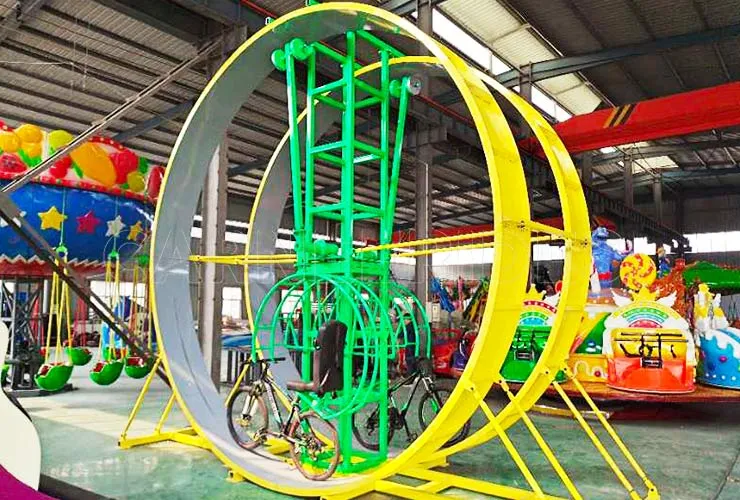
Human-powered attractions involve visitors, parents or operators directly in the movement of the equipment.
Examples include:
These rides are particularly suitable for projects that want to add more interaction between children, parents and other visitors.
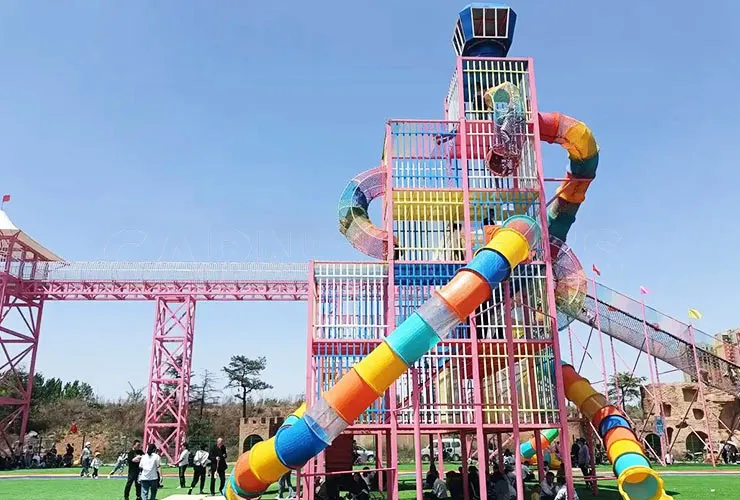
Climbing structures, rope courses, towers, obstacle elements and adventure equipment introduce physical challenge and exploration.
They can be designed as individual attractions or combined into larger adventure zones depending on the available site.
For larger projects, climbing and crossing elements can also help create visual landmarks and connect different activity areas.
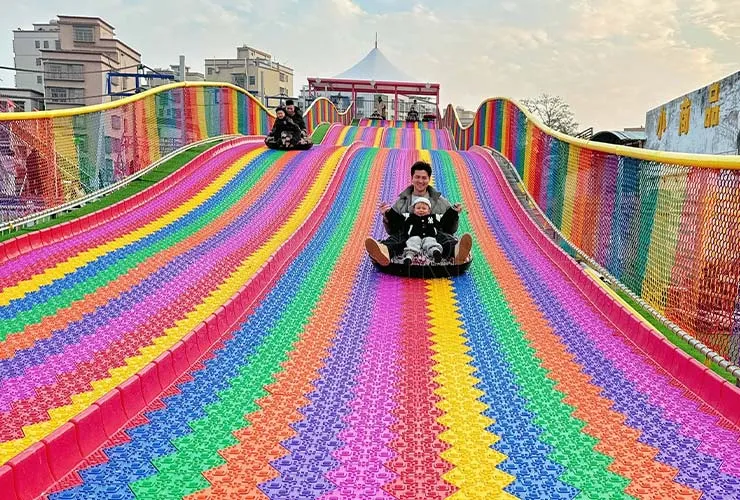
Slides use terrain, structural height or gravity to create movement without conventional powered propulsion.
This category can include:
The correct configuration depends on available height, terrain, landing space and expected visitor capacity.
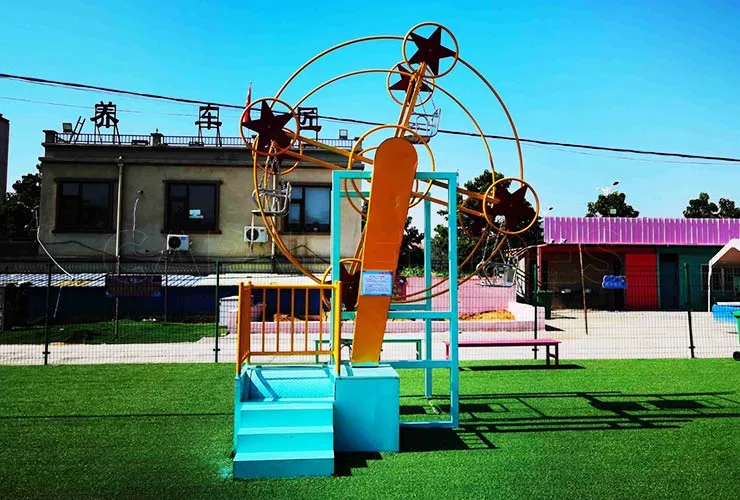
Swings, seesaws, rotating attractions and other interactive equipment can add shared play experiences without requiring a large mechanical ride system.
These attractions are useful for creating variety between more physically demanding climbing or adventure activities.
The objective is not to install as many products as possible. A stronger equipment mix gives visitors different reasons to participate throughout the park.
The best non-powered amusement equipment is not necessarily the largest or most visually complex product.
It is the equipment that fits the site’s visitor profile, available land and operating requirements.
Before confirming the equipment list, consider five key factors.
Total land area does not equal usable equipment area.
Buildings, trees, slopes, entrances, existing attractions, visitor circulation and maintenance access can all reduce the space available for equipment.
A long narrow site may require a completely different equipment mix from a square site with the same total area.
A park aimed mainly at younger children should not use the same attraction mix as a project designed for school-age children, teenagers and families.
Equipment selection should reflect the physical abilities and expected play behavior of the target users.
A small resort activity area and a high-traffic scenic park may require very different capacities.
Popular attractions should be positioned and selected with queueing, loading, circulation and visitor distribution in mind.
A farm park, resort, scenic attraction and urban family park each have different operating conditions.
The same equipment package should not simply be copied from one site to another.
The equipment quotation is only one part of the project.
Depending on the site, the complete budget may also include civil works, foundations, surfacing, freight, unloading, installation, landscaping and local labor.
For projects that are still in the planning stage, our non-powered amusement park layout guide explains how zoning, circulation and attraction placement should be coordinated before the final equipment package is confirmed.
Ground conditions, slopes, drainage, installation access and foundation or fixing requirements should be reviewed before the final equipment layout is confirmed. For some projects, local structural, wind or civil-work requirements may also affect the equipment configuration and installation plan.
These factors should be confirmed according to the selected equipment, actual site conditions and destination requirements rather than assumed from a standard catalogue layout.
As a professional non-powered amusement park equipment manufacturer and project solution provider, Carnee Rides develops equipment proposals around the actual site conditions rather than relying only on fixed product packages.
For customized projects, the planning process can begin with:
site dimensions + site plan or CAD + photos/video + target visitors + preferred attractions + destination country + budget range
Based on the project requirements, the equipment configuration can then be adjusted in areas such as layout, dimensions, color scheme, thematic appearance and attraction combination, subject to engineering feasibility.
Carnee Rides can also support international projects with equipment selection, preliminary layout planning, equipment supply, export packing, shipping coordination and installation guidance according to the agreed project scope.
For developers planning a complete family attraction rather than purchasing individual products, see our turnkey non-powered amusement park solutions.
This site-based approach is especially useful for projects where:
1. Site Review
Site dimensions, CAD drawings, photos, terrain, target visitors and project requirements.
2. Layout & Equipment Proposal
Functional zoning, equipment selection, customization and preliminary layout.
3. Technical & Commercial Confirmation
Equipment specifications, project scope, packing, quotation and required technical information.
4. Production, Shipping & Installation Support
Equipment supply, export packing, shipping coordination and installation guidance according to the agreed project scope.

Founded in 1998
Over 25 years of experience in amusement equipment supply and project support.
80+ Countries & Regions
Non-powered amusement projects and equipment have been supplied to customers across more than 80 countries and regions.
200+ Non-Powered Projects & Clients
Practical experience supporting different park sizes, site conditions and project types.
70,000 m² Manufacturing Facility
Production and equipment supply capabilities to support customized commercial amusement projects.
Site-Based Custom Planning
We review your site dimensions, CAD drawings, visitor groups and project requirements before recommending an equipment mix and layout.
International Project Support
Support can include export packing, shipping coordination, technical documentation, installation guidance and after-sales service according to the agreed project scope.
Carnee Rides can support a non-powered amusement park project from early equipment planning through delivery and installation support. Depending on the agreed project scope, services may include site information review, equipment selection, preliminary layout planning, customized design, equipment supply, export packing, shipping coordination, technical documentation, installation guidance and after-sales support.
For a complete park project, send us your site dimensions or CAD drawing, destination country, target visitors, preferred attractions and budget range so that the equipment proposal can be developed around the actual project conditions.
A non-powered amusement park can cost from around USD 50,000 for a small outdoor play area to USD 2.5 million or more for a large destination-scale project.
As an early planning reference, a small project may require approximately USD 50,000–200,000+, a medium family amusement park around USD 200,000–800,000+, and a larger commercial park approximately USD 800,000–2,500,000+. Destination-level projects with extensive custom equipment, multiple activity zones and supporting facilities may exceed USD 2.5 million.
The final investment depends on the site size, equipment mix, customization, foundations and civil works, safety surfacing, landscaping, shipping, installation and local labor. These figures are planning references rather than fixed quotations.
For a more detailed cost breakdown, see our non-powered amusement park cost guide.
Yes. Many non-powered amusement attractions can be customized according to the available site, target visitors and project theme, subject to the structure and engineering feasibility of the selected equipment.
Customization may include equipment layout, dimensions, color combinations, thematic appearance and attraction combinations.
For the most useful proposal, provide a CAD drawing or site dimensions, photos or video, entrance locations, target age groups and any existing buildings or landscape features that must remain.
For international projects, equipment is prepared for export according to the selected products and agreed packing scope. Carnee Rides can assist with export packing, shipping coordination, technical drawings and installation guidance.
The exact responsibilities for international freight, customs clearance, unloading, cranes or forklifts, local labor, foundations and on-site installation should be confirmed before shipment.
For larger customized projects, the installation support arrangement can be discussed as part of the quotation and project scope.
Safety should be considered throughout equipment design, manufacturing, installation, operation, inspection and maintenance rather than judged from one feature alone.
Depending on the attraction, important considerations can include structural design, connections, moving components, passenger restraints where applicable, use areas, foundations or fixing, surfacing, operating procedures and regular inspection.
Applicable requirements also vary by equipment category and destination country. Buyers should therefore confirm the technical documents and compliance requirements for the specific equipment being purchased rather than assuming that one standard applies to every attraction.
Materials depend on the type and configuration of the equipment. Commercial non-powered attractions may use structural steel, ropes or nets, engineered panels, FRP components, plastics, timber or other materials according to the selected product.
For customized projects, the main material specifications, structural requirements, surface finish and other technical details should be confirmed in the product specification or quotation before production.
If your destination has specific material, corrosion-protection or climate requirements, provide them during the quotation stage so they can be reviewed for the selected equipment.
When comparing non-powered amusement equipment manufacturers, do not judge the supplier only by equipment price or product photos.
A commercial buyer should compare the manufacturer or supplier’s project experience, equipment specifications, customization capability, technical documentation, quotation scope, shipping arrangements, installation support, spare-parts availability and after-sales communication.
It is also useful to ask whether the supplier can review your actual site before recommending the final equipment list. A quotation based only on a product catalogue may not account for site constraints, visitor flow or supporting project costs.
Carnee Rides has been involved in amusement equipment projects since 1998 and supports overseas buyers with site-based planning, customized equipment supply and international project coordination.
Depending on the selected equipment and agreed project scope, Carnee Rides can provide relevant technical or installation drawings and foundation information to support site preparation. Final civil works and foundations should be confirmed according to the actual site conditions, selected equipment and local project requirements before construction.
The typical production time for non-powered amusement equipment is approximately 15–30 days after the equipment specifications, customization requirements and order details are confirmed.
For larger customized amusement park projects, the production schedule may vary depending on the equipment quantity, project complexity and customization scope.
International shipping time is additional and depends on the destination country, shipping method and port schedule. Carnee Rides can provide an estimated production and delivery timeline together with the project quotation.
If you are purchasing more than individual equipment, start with the site rather than the product catalogue.
Send Carnee Rides your:
site dimensions or CAD drawing + site photos/video + destination country + target visitor groups + preferred attractions + budget range
and our team can review the project requirements before recommending an equipment combination and preliminary layout.